Download Call for Papers (PDF)
Submission Deadline: July 31, 2027
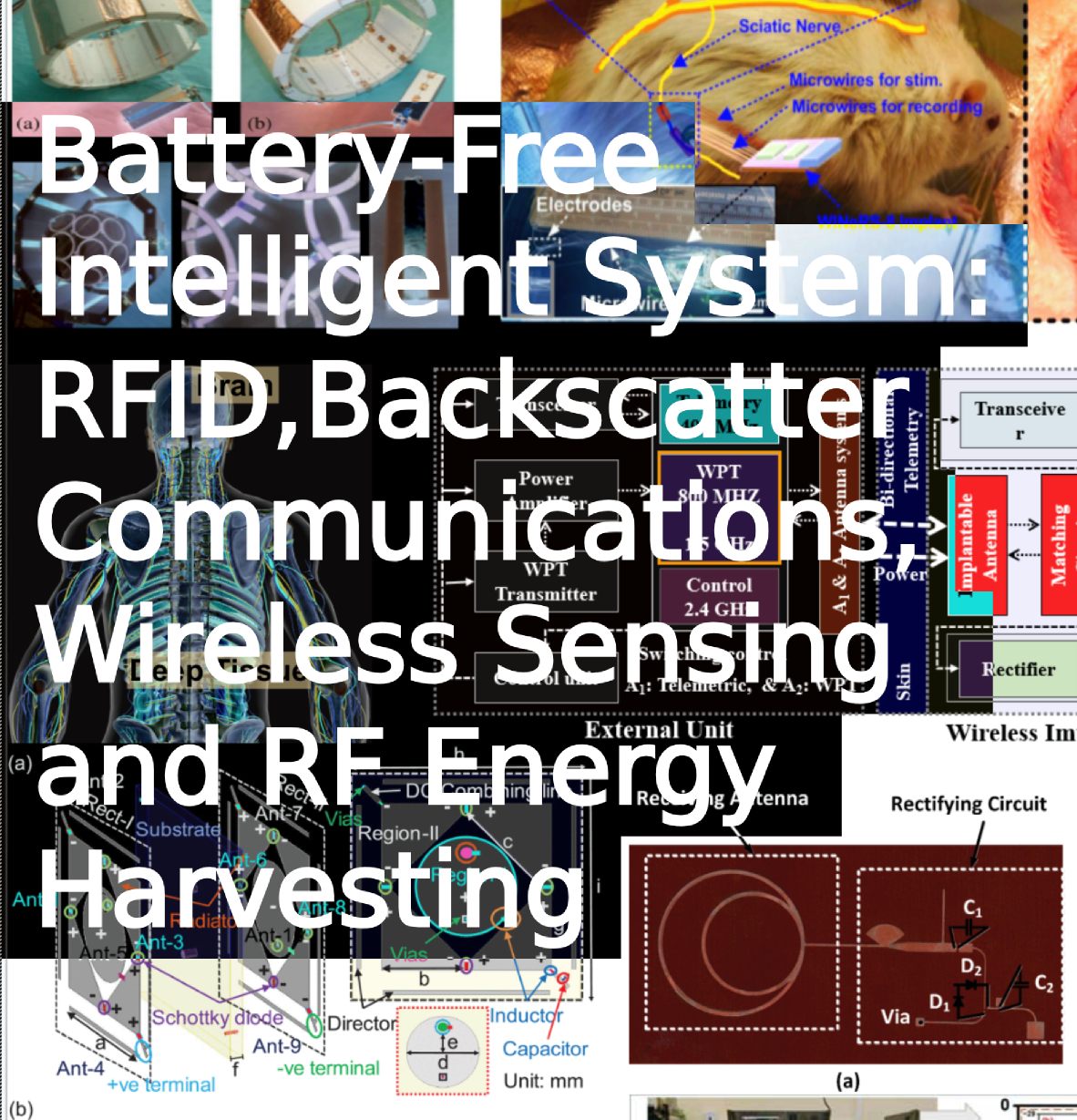
Battery-free wireless systems have attracted significant attention in recent years due to advances in antennas and propagation, radio-frequency identification (RFID), backscatter communication, RF energy harvesting, wireless power transfer (WPT), and low-power sensing. These systems enable sensing, identification, localization, and communication without conventional batteries, offering a practical solution for large-scale deployments where battery replacement and maintenance impose significant cost and operational constraints. Electromagnetic energy is the basis of battery-free operation, where antennas capture, radiate, and manipulate RF power. Propagation conditions determine the availability of RF energy and the reliability of communication links. RFID and backscatter systems use electromagnetic waves for both power delivery and information transfer, resulting in strong coupling among antenna characteristics, propagation environments, circuit operation, and system performance. Consequently, advances in antenna design, propagation modeling, scattering analysis, rectifying structures, and wireless power transfer directly influence communication range, RF-to-DC conversion efficiency, sensing capability, and network scalability.
Recent research has expanded the scope of battery-free technologies beyond conventional RFID platforms. Chipless RFID, computational RFID, ambient backscatter communication, rectennas, self-powered sensors, distributed wireless power transfer, integrated sensing and communication (ISAC), and intelligent electromagnetic structures continue to expand the capabilities of energy-autonomous systems. At the same time, these developments introduce important challenges related to antenna–rectifier co-design, propagation aware optimization, multiband operation, low-power sensing, electromagnetic characterization, and large-scale deployment in complex environments. This Special Section seeks contributions that advance the theory, design, implementation, and applications of battery free intelligent systems. The Section places particular emphasis on antenna and propagation aspects of RFID technologies, backscatter communication, RF energy harvesting, wireless power transfer, rectennas, and self-powered sensing platforms. Contributions addressing fundamental electromagnetic principles, novel antenna architectures, propagation studies, circuit and system integration, experimental validation, and practical applications are particularly encouraged.
This Special Section will bring together researchers from the antennas and propagation, microwave engineering, RFID, wireless power transfer, and sensing communities and will highlight recent advances that support the development of next-generation energy-autonomous wireless systems.
Potential topics include but are not limited to the following:
- RFID Systems and Applications
- Chipless RFID and Computational RFID
- RFID-Based Localization and Tracking
- Battery-Free Wireless Sensing Systems
- Self-Powered Sensors and Sensor Networks
- Backscatter Communication Systems and Networks
- Ambient Backscatter Communication
- Wireless Sensing Using Backscatter and RFID Technologies
- RF Energy Harvesting and Energy-Autonomous Systems
- Rectennas, Rectifier Circuits, and RF-to-DC Conversion
- Ambient RF Energy Harvesting
- Wireless Power Transfer for Battery-Free Devices
- Simultaneous Wireless Information and Power Transfer
- Antennas for RFID, Backscatter, and Energy Harvesting
- Antenna-Rectifier Co-Design
- Propagation Modeling and Channel Characterization for Battery-Free Systems • Electromagnetic Modeling and Scattering Analysis
- Low-Power Circuits and System Integration
- Wearable and Flexible Battery-Free Platforms
- Internet-of-Things Applications of Battery-Free Systems
- Biomedical, Healthcare, Industrial, and Smart Infrastructure Applications
Manoj Kumar
Indian Institute of Technology, India
Hyoungsuk Yoo
Hanyang University, South Korea
M. Jaleel Akhtar
Indian Institute of Technology, India
Photos Vryonides
Frederick University Cyprus
Chaoyun Song
King's College of London, UK