PULSE Doctoral School on Reconfigurable Electromagnetic Metadevices
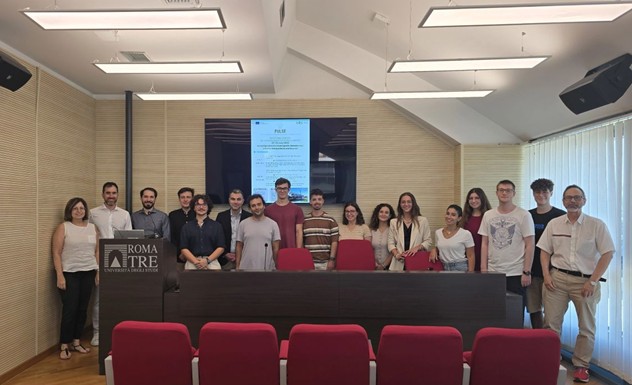
On 22-23 July 2026, Roma Tre University hosted the PULSE Doctoral School Reconfigurable Electromagnetic Metadevices: Plasma, Metasurfaces and Beyond, co-sponsored by the IEEE Antennas and Propagation Society Technical Committee on Metamaterials (IEEE AP-S TC4).
The two-day school took place at the Department of Industrial, Electronic and Mechanical Engineering and brought together more than 30 participants, mainly PhD students and postdoctoral researchers, as well as MSc students, early-career researchers, and professionals. Participation was free of charge, helping make advanced training in emerging electromagnetic technologies accessible to young researchers.
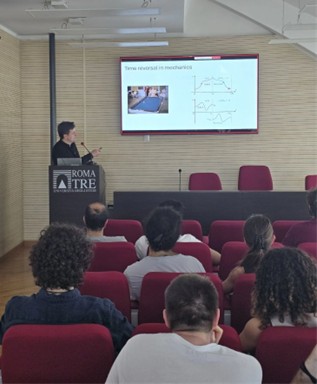
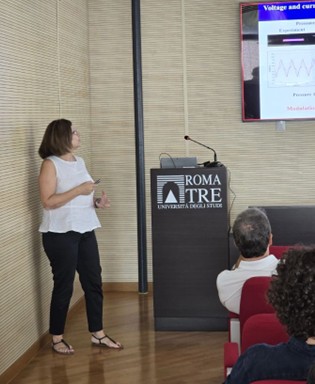
The programme combined fundamental concepts with examples drawn from the research activities carried out within the PULSE project. Lectures addressed electromagnetic nonreciprocity, metasurfaces and metagratings, plasma physics fundamentals, plasma modelling and simulation, and electromagnetic simulations of static and time-varying plasma-based metadevices.
Contributions were delivered by lecturers from Aalto University, Roma Tre University, Metamorphose VI, the University of Bologna, the Foundation for Research and Technology - Hellas (FORTH), and Universidad Politécnica de Madrid, giving the school a strong international and multidisciplinary character.
By connecting plasma physics, metamaterials, computational electromagnetics, antennas, and wave propagation, the school highlighted research directions of growing relevance to the IEEE AP-S community. Plasma-based and reconfigurable metadevices offer new approaches to controlling electromagnetic-wave transmission, scattering, beam forming, and nonreciprocal propagation, with potential applications in adaptive antennas, reconfigurable communication systems, sensing, and advanced propagation environments.
The school also provided a valuable opportunity for participants to exchange ideas, develop new technical connections, and engage with emerging topics at the boundaries of electromagnetic engineering.