IEEE AP-S TC2 × AP-S/URSI Workshop
Phased Antenna Arrays and Reconfigurable Intelligent Surfaces
Date and Time: Sunday, 12 July 2026 | 09:00 to 14:00
Location: Detroit, Michigan, USA
Venue: Huntington Place Convention Center, Room 251C
Chair: Prof. Dr. Diego Caratelli
Overview
The IEEE AP-S Technical Committee 2 (Antenna Arrays and Systems) held its extended half-day workshop on Phased Antenna Arrays and Reconfigurable Intelligent Surfaces (RIS), designated HD-9, on Sunday 12 July 2026 at the AP-S/URSI 2026 symposium in Detroit. The workshop was organized by TC-2 in cooperation with TC-4 (Electromagnetic Metamaterials and Metadevices), chaired on site by Prof. Dr. Diego Caratelli (Eindhoven University of Technology and The Antenna Company, TC-2 Vice-Chair), with Prof. Alessio Monti (Roma Tre University, TC-4 Chair) as co-organizer.
The program brought together nine invited talks from leading academic and industrial groups across three thematic blocks, spanning the physics of engineered surfaces, system-level integration and emerging implementation technologies, and the synthesis, digital architectures, and validation of active phased arrays. All nine talks were delivered as planned, including one remote presentation carried live over a hybrid audio-video link. Each talk ran thirty minutes including questions, with two fifteen-minute breaks separating the blocks.
Program and Invited Talks
Block I: Foundations and Architectures of Reconfigurable Surfaces and Arrays (09:00 to 10:30)
The opening block established the device-level foundations of engineered surfaces and reconfigurable apertures.
George V. Eleftheriades (University of Toronto, Canada) | 09:00 to 09:30
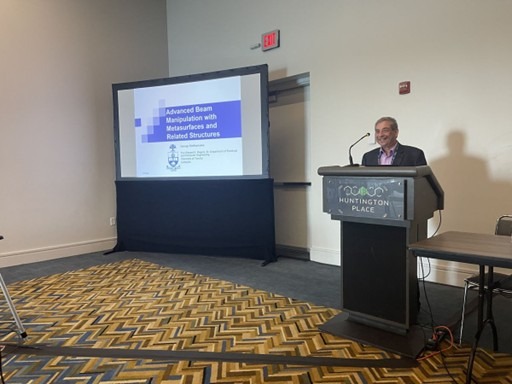
Advanced Beam Manipulation with Metasurfaces and Related Structures
The talk presented recent advances in metasurfaces for beam steering and beam shaping in the far zone, introducing a paradigm in which engineered surfaces provide complete control of transmitted or reflected waves without loss or gain. The key enabling feature is the use of surface waves to change the phase of the manipulated waves while allowing amplitude control through power redistribution. Surface-wave-assisted architectures for steered, shaped, and multiple beams were discussed, together with electrically thin reflectors that minimize beam squint, electronically reconfigurable prototypes, and new phased-array topologies with reduced complexity and cost.
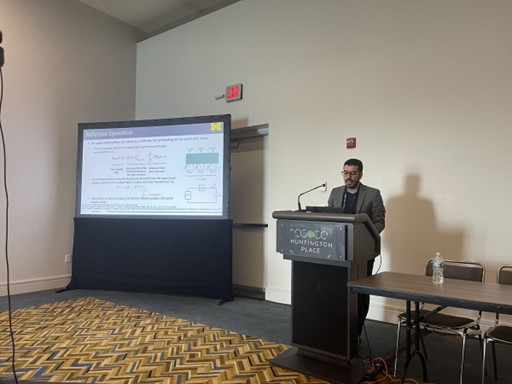
Malik Almunif, presenting joint work with Anthony Grbic (University of Michigan, USA) | 09:30 to 10:00
Beamforming with Reactively Loaded Metasurfaces
The talk described how a metasurface connected to reactive loads or networks can serve as a low-cost beamforming technology. The reactively loaded metasurface consists of a grid of subwavelength unit cells connected to individual ports, of which some are directly excited while the remainder are terminated in reactive loads and act as parasitic radiators. Strong inter-cell coupling, tailored by the reactive loads, shuttles energy across the aperture to enable beam steering, beam shaping, and multiple beams driven by separate feeds. The presentation was delivered by Mr. Almunif, as Prof. Grbic was due to arrive later in the day.
Francesco Foglia Manzillo (CEA-Leti, France) | 10:00 to 10:30
Advanced Beam-Steering and Polarization-Agile Transmitarray Antennas for 5G and Satellite Communications
The talk presented advances in the modeling, design, and experimental validation of electronically reconfigurable transmitarray antennas based on p-i-n diodes for 5G and satellite communication bands. Architectures enabling dynamic beamforming and polarization agility with coarse phase quantization and reduced hardware complexity were reviewed and compared in terms of performance and energy efficiency. Novel high-gain, low-profile architectures using sparse arrays as primary feeds were described, showing that co-optimizing the feed and the transmitarray can reduce overall antenna thickness to a few wavelengths while preserving high gain and wide-angle scanning, and the proposed transmitarrays were benchmarked against conventional phased arrays at system level.
Block II: System-Level Integration, Applications, and Emerging Implementation Technologies (10:45 to 12:15)
The second block addressed how phased-array and RIS technologies translate into deployed wireless systems.
Manos M. Tentzeris (remote presentation from Greece) (Georgia Institute of Technology, USA) | 10:45 to 11:15
Autonomous Additively Manufactured FHE-Enabled Wireless/5G+ Antenna Arrays and Modules for IoT, SmartAg, Industry 4.0 and AI-enabling ISAC/JCAS Applications
Delivered live over the hybrid link, the talk introduced inkjet- and 3D-printed antennas and arrays, interconnects, smart encapsulation, RF electronics, RFIDs, microfluidics, and sensors on glass, PET, paper, and other flexible substrates as a system-level route to ultra-low-cost mass production of millimeter-wave and sub-THz modules and metasurfaces for communication, energy harvesting, and sensing. Topics ranged from fully printable broadband wireless modules and 3D-printed interconnects up to 300 GHz, through near-perpetual RF modules powered by wireless power grids and multi-source energy harvesting, to shape-changing 4D-printed origami phased arrays and massively scalable tile-by-tile RFID-enabled autonomous reconfigurable intelligent surfaces, closing with the five S challenges of scalability, sustainability, speed, security, and smartness.
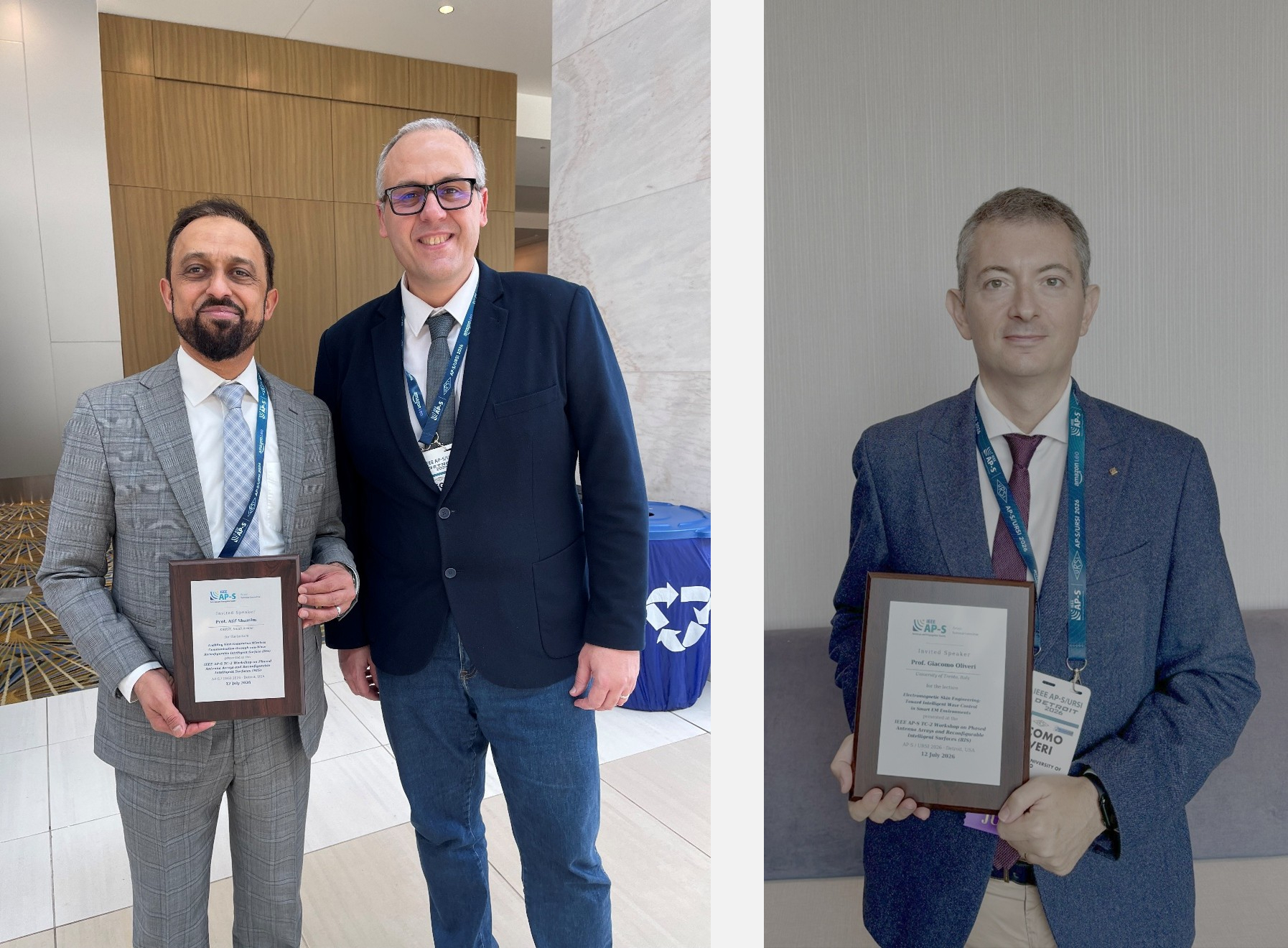
Atif Shamim (King Abdullah University of Science and Technology (KAUST), Saudi Arabia) | 11:15 to 11:45
Enabling Next Generation Wireless Communication through mm-Wave Reconfigurable Intelligent Surfaces (RIS)
The talk addressed the gap between the extensive theoretical literature on RIS and the scarcity of practical wideband implementations at millimeter-wave frequencies. After introducing the fundamental concepts, it presented the electromagnetic design, prototyping, and complete experimental characterization of a wideband RIS covering the mm-wave 5G band from 22.5 to 29.5 GHz, about twenty-seven percent bandwidth, with beam scanning to fifty degrees. Further designs included a fully screen-printed wideband RIS using novel printed switches based on vanadium dioxide phase-change material, and a RIS realized with optically transparent metallic ink.
Giacomo Oliveri (University of Trento, Italy) | 11:45 to 12:15
Electromagnetic Skin Engineering: Toward Intelligent Wave Control in Smart EM Environments
The talk surveyed recent trends in the synthesis, engineering, and application of wave-manipulation devices for wireless communications within the Smart Electromagnetic Environment framework. Electromagnetic Skins were presented as an enabling technology extending the traditional metasurface concept in both functionality and design methodology. The presentation covered constrained design methods based on non-radiating current distributions, advanced field control for fixed and mobile wireless links, and the development of next-generation low-cost Electromagnetic Skins for future integrated sensing and communication systems.
Block III: Array Synthesis, Digital Architectures, and Validation (12:30 to 14:00)
The closing block followed the design, build, and validate cycle of digital and active phased arrays.
Yuandan Dong (University of Electronic Science and Technology of China (UESTC), China) | 12:30 to 13:00
Intelligent Reconfigurable Array Architectures for Next-Generation Wireless
The talk covered recent advances in reconfigurable array architectures for next-generation communication, sensing, radar, and satellite systems. Starting from intelligent small antennas with wave steering, multiple novel phased arrays were presented, including metasurface antennas with dynamic amplitude and phase control, phased arrays exploiting amplitude modulation, and leaky-wave antennas combining amplitude and frequency modulation for dispersion manipulation.
Teun van den Biggelaar (ANTENNEX, the Netherlands) | 13:00 to 13:30
Over-the-Air Characterization of Active Phased Array Systems
The talk presented reverberation-chamber techniques as the over-the-air equivalent of the coaxial cable for characterizing active phased arrays, bridging the gap between the conducted and radiated domains. Metrics addressed included total radiated power, noise figure, error vector magnitude, compression, and modulation distortion, illustrated with measured results on state-of-the-art millimeter-wave antenna-in-package and multi-element array hardware.
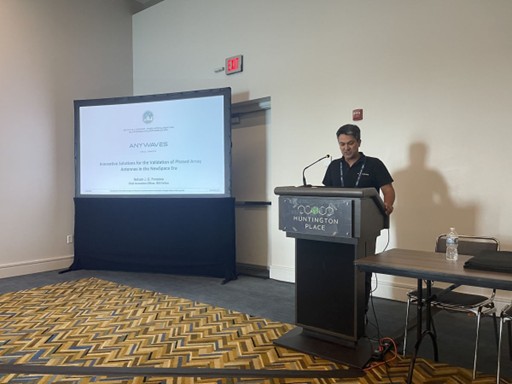
Nelson J.G. Fonseca (Anywaves, France) | 13:30 to 14:00
Innovative Solutions for the Validation of Phased Array Antennas in the NewSpace Era
Closing the program, the talk addressed validation techniques and methodologies for phased array antennas in the NewSpace context, where compressed development cycles and cost constraints demand innovative approaches to testing and qualification of space-segment antenna systems, drawing on the speaker's experience across multiple-beam antennas for space missions, beamformer theory and design, and novel manufacturing techniques.
Appendix: Photographic Impressions
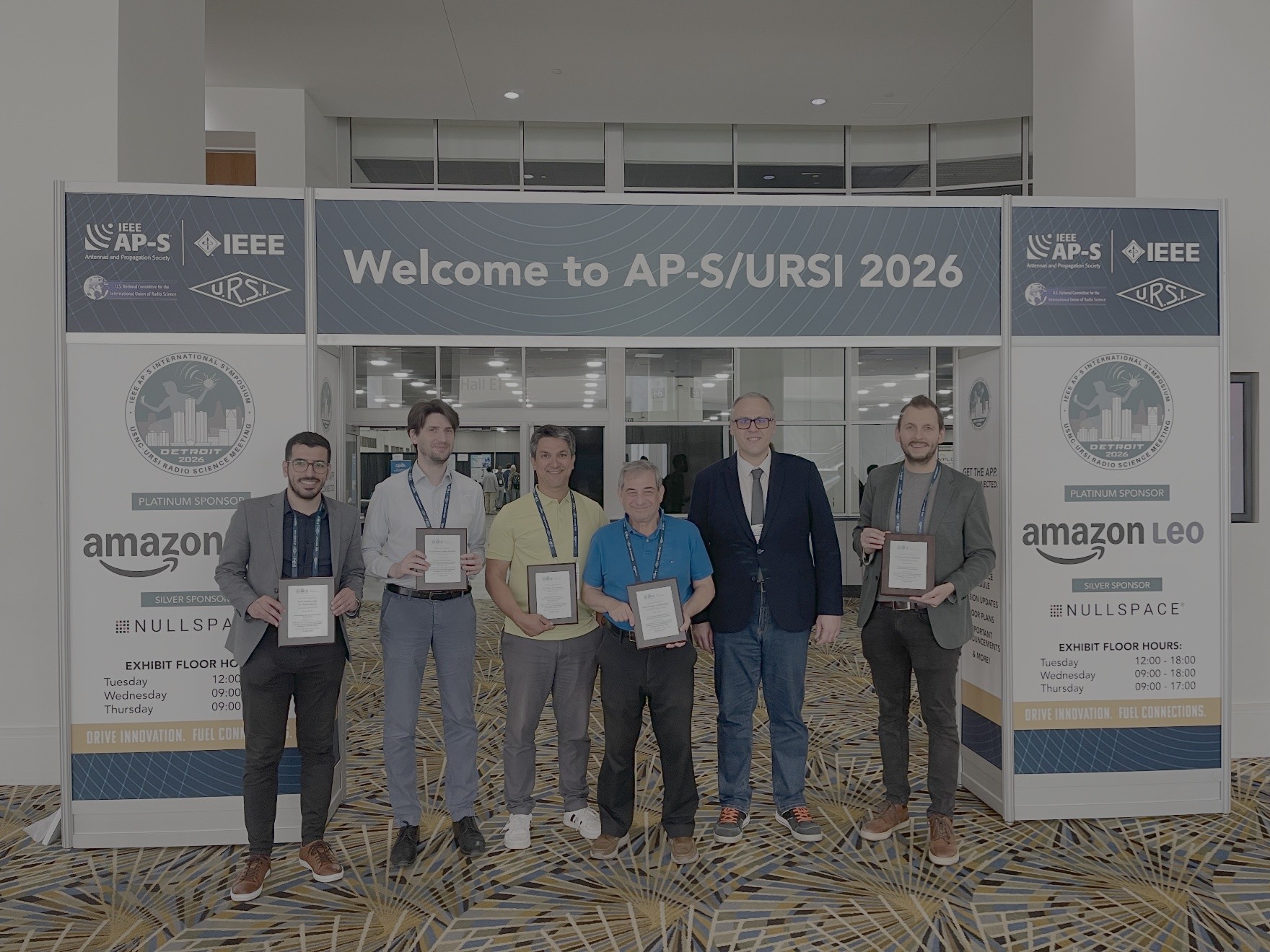
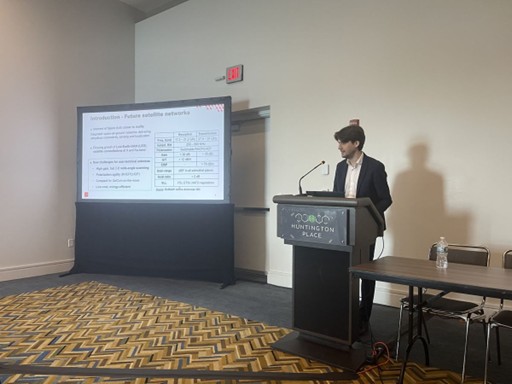
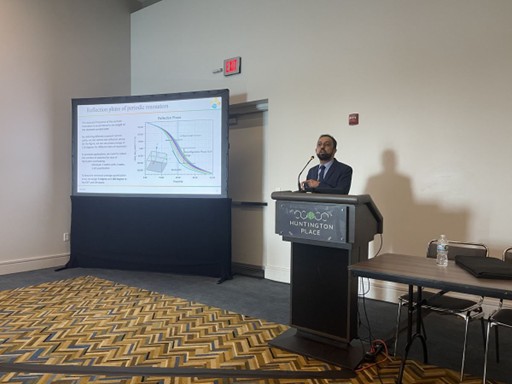
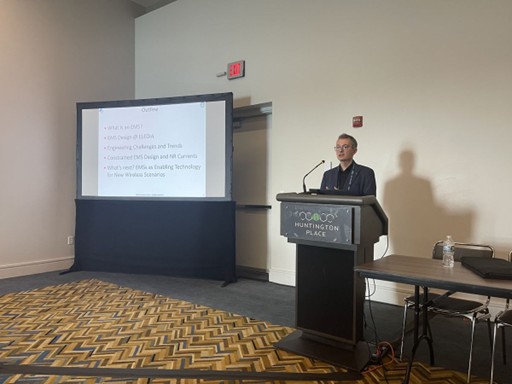
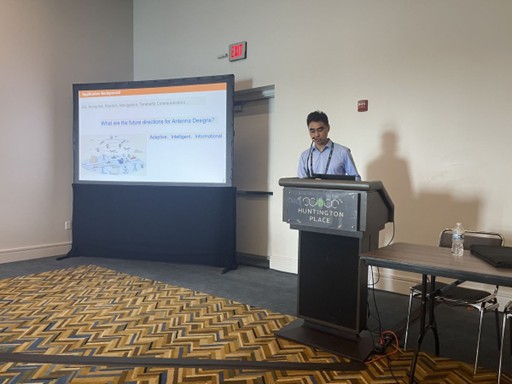
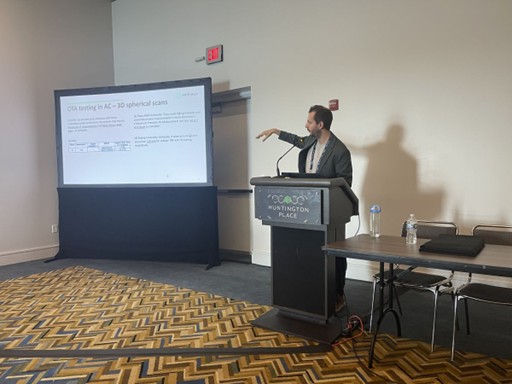
A selection of photographs taken during the workshop on 12 July 2026.